

by Dr. Michelle Allen
The smaller the island, the greater the supply challenges. However, this is relative, as some small islands have comparatively large populations. A critical but often overlooked issue in island tourism is that supplies commonly arrive via sea. Construction materials, breakfast buffets, guest room linens, fuel for the airport shuttle, and replacement parts for the resort’s water system all must arrive by sea to reach a small island. These items are usually shipped through a single port, often on a tight schedule, making port infrastructure critical for the sustainable development of islands.
For island destinations, supply chain logistics is a prime concern for island sustainability and resiliency. It dictates what a destination can offer, when it can offer experiences, what that offer costs, and how quickly it recovers when something goes wrong.
Why Islands Face a Different Logistics Problem
Three structural conditions set small island destinations apart. The first is import dependence. The Caribbean imports a large share of the food it consumes, and CARICOM figures cited by the Caribbean Regional Fisheries Mechanism put the region’s food import bill at roughly US$13.76 billion across 2018 to 2020. Tourism activities drive this demand directly through rising visitor numbers, and indirectly through increased domestic consumption of foreign goods. Hotels, restaurants, and other establishments cater to tourists who expect a consistent, often imported, selection of goods.
The second is limited shipping connectivity. UNCTAD reports that maritime connectivity for Small Island Developing States has declined by approximately 9 percent over the past decade. Fewer and smaller vessels calling at island ports mean less choice of routes and higher freight costs per unit, since small cargo volumes do not allow these vessels to achieve economies of scale. A 2026 IMF analysis found that limited physical connectivity, specifically shipping and air links, is a more decisive constraint on Caribbean trade than financial connectivity.
The third is exposure to hazard. A hurricane can close a port for days or weeks, and on an island there is rarely a road detour. In the archipelagic Bahamas, Family Island communities depend on scheduled mail boats and on goods that often transit through Florida ports first. Every extra port of call introduces another potential delay.
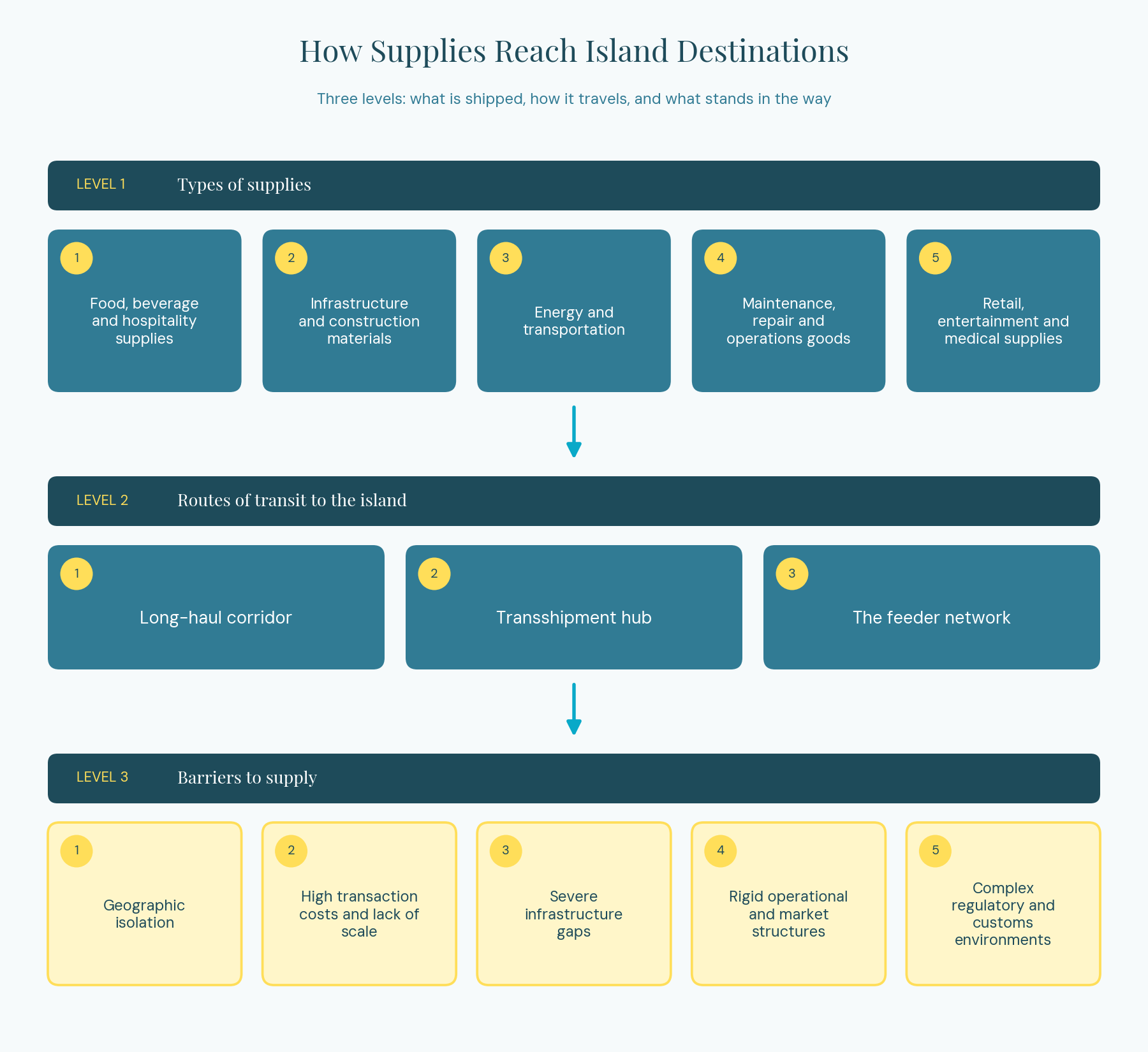
Three-level diagram of island tourism supply chains: types of supplies, routes of transit to an island, and barriers to supply.
Source: Author’s own work; Figure drawn using Claude (Anthropic).
What This Means for Tourism Businesses
These conditions show up in everyday operating decisions. Lead times are long, so hotels hold more inventory than a mainland property would. Cold storage becomes a core asset, and a shortage of temperature-controlled transportation can significantly affect the quality of perishable items. Freight and handling costs are built into prices, and narrow margins make tourism operators sensitive to global disruptions.
Tourism leakage further compounds operators’ flexibility to respond to market shifts and price increases. Tourism leakage describes the share of visitor spending that leaves the destination to pay for imports instead of circulating locally. The more a resort depends on imported inputs, the more of each visitor’s dollar leaves the island. Supply chain design is therefore tied directly to how much tourism benefits local communities.
How the Industry Manages the Challenge
Destinations and operators are not passive here. The literature suggests four approaches stand out in practice.
Buffer planning. To prepare for seasonal shifts and hurricanes, properties develop robust stock plans, with extra dry goods, water, fuel, and spare parts. Buffer planning involves cold storage investment and backup power for at least two weeks to avoid kitchen disruptions. While larger islands can buffer adequately based on the high domestic cargo volume, smaller islands face much greater challenges.
Cooperative purchasing. Hotels, restaurants, and suppliers that order together can consolidate shipments, secure better freight terms, and share storage, which manages demand for carriers serving small ports. This can involve the formalisation of a procurement alliance to facilitate bulk purchasing.
Local and regional sourcing. Linkages between hotel kitchens and nearby farmers and fishers shorten the supply chain, reduce exposure to shipping disruptions, and keep more spending in the community. However, these local supply chains require consistent volumes, quality standards, and reliable payment, areas where organised producer groups and tourism buyers must work as partners. Inter-island ferry services are particularly important for regional sourcing.
Diversified routes and suppliers. Tourism operators who can source through more than one port or regional hub have options when a single route fails. Unlike small islands, larger islands have multiple access points, as they often possess multiple ports, extensive highways, and expansive warehousing opportunities.
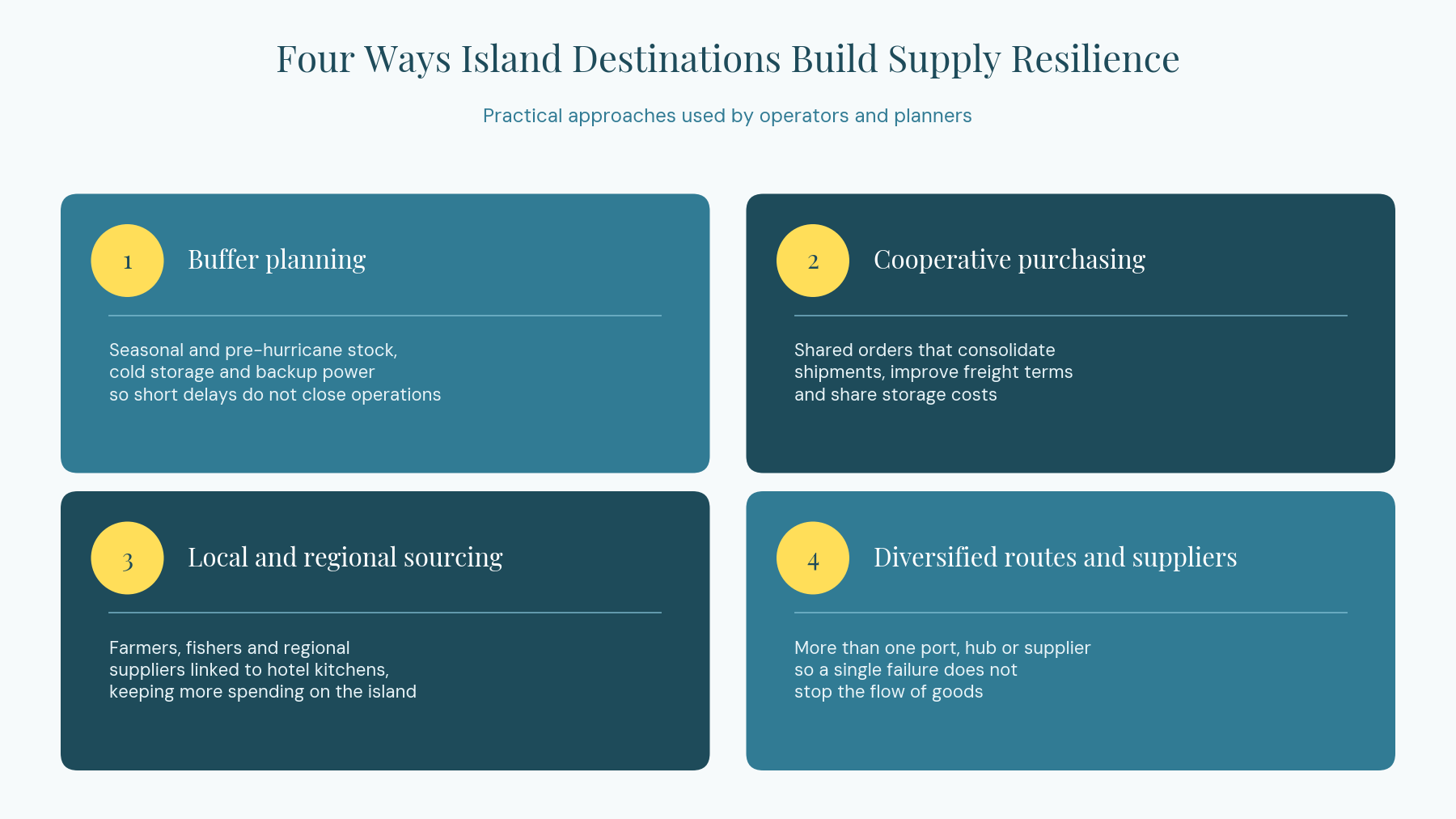
Diagram of four strategies island tourism businesses use to strengthen supply chains: buffer planning, cooperative purchasing, local sourcing and diversified routes
Source: Figure drawn using Claude (Anthropic).
A Question for Policymakers
This raises an important question for policymakers: if supply chain resilience is part of destination resilience, where does it appear in tourism policy? Port investment, regional shipping links, temperature-controlled supply chain infrastructure, and support for local farmers and producers are often planned in isolation from broader tourism strategy. Planning them together is likely to be more effective, and community-led approaches show how local knowledge and local producers can anchor that effort.
Island tourism will always depend on connections to the wider world. The practical task for operators and planners is to strengthen the reliability of those connections and ensure more of their economic value remains on the island.
References
Ahn, J., Marieatte, N., Mengel, P.-L., Moore, D., Quast, J., Tao, Q., & Wang, H. (2026, May 15). Mind the gaps: Caribbean trade patterns and the connectivity constraint (IMF Working Paper No. 2026/095). International Monetary Fund. https://www.elibrary.imf.org/view/journals/001/2026/095/article-A001-en.xml
Caribbean Regional Fisheries Mechanism. (2024, July 5). Vision 25 by 2030 CARICOM initiative. CRFM. https://crfm.int/index.php?option=com_k2&view=item&id=819
United Nations Trade and Development. (2024, October 22). Latin America and the Caribbean: Shipping struggles amid geopolitical and climate crises. UNCTAD. https://unctad.org/news/latin-america-caribbean-shipping-struggles-amid-geopolitical-and-climate-crises