

What the Sargassum Crisis Reveals About Marine Tourism Resilience
by Dr. Michelle Allen
Every Spring, coastal regions across the Caribbean and Gulf of Mexico confront a predictable and escalating environmental challenge: the seasonal influx of sargassum seaweed. What was once an occasional ecological occurrence has become a persistent threat affecting the region’s tourism calendar, as confirmed by the events of 2026. According to NASA Earth Observatory and the University of South Florida’s Optical Oceanography Laboratory, June 2026 was the second-highest Sargassum year in the satellite record, behind only 2025, and the Caribbean Sea and Gulf of Mexico both hit all-time regional highs. For destinations built around marine tourism, resilience now means planning around sargassum as a certainty, not an exception.
The sargassum crisis is not really a story about seaweed. It is a story about how destinations respond when an ecological disruption stops being a rare emergency and becomes a permanent planning variable. That question sits at the center of my forthcoming co-edited book, Tourism Case Studies: Community-led Marine Tourism for Resilience, Restoration and Equity.
What’s Driving the 2026 Sargassum Bloom
In June 2026, the Eastern Caribbean carried roughly 9 million metric tons of Sargassum, the Western Caribbean 3.6 million, and the Gulf of Mexico 5 million, nearly double its previous record, itself set only a year earlier in 2025 (NASA Earth Observatory, 2026).
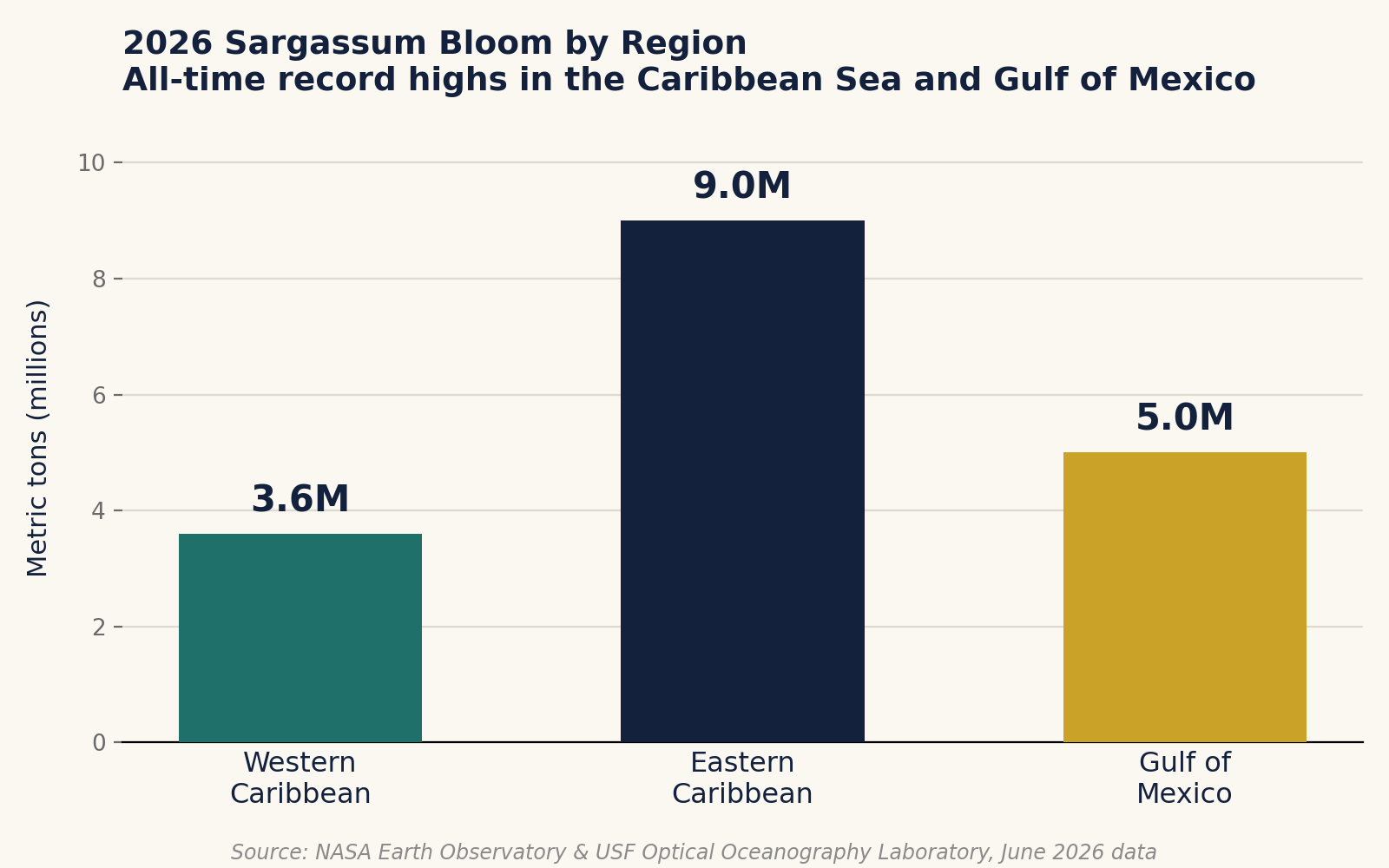
A bar chart of the 2026 sargassum bloom by region, showing 9 million metric tons in the Eastern Caribbean, 3.6 million in the Western Caribbean, and 5 million metric tons in the Gulf of Mexico, illustrating the marine tourism resilience challenge.
Impact on Marine-Tourism-Dependent Destinations
For destinations built on clear water and clean beaches, sargassum is an existential threat disguised as a nuisance. Heavy landings can close beaches to swimming, smother the reefs and seagrass beds that dive and snorkel operators depend on, and release hydrogen sulfide as they decompose, a rotten-egg smell that guests notice immediately. Mexico alone had cleared more than 105,000 metric tons of sargassum by mid-August 2026, already surpassing the prior year’s record of roughly 92,800 tons, according to Reuters reporting on the government’s cleanup effort.
The economic exposure remains starkly uneven. While larger resorts with deep capital reserves can absorb a difficult season by shifting marketing strategies and deploying heavy equipment, smaller island communities and locally owned operators, those with the least capacity to weather a lost season, bear the brunt of the impact.
Reactive Cleanup vs. Research-Informed Adaptive Sargassum Management
Most destinations still respond to sargassum the way they respond to a storm: reactively, raking beaches and deploying barriers only after a sargassum mat has already landed. A research-informed adaptive model works differently. It uses satellite forecasting to anticipate landings weeks in advance, prioritizes offshore interception over shoreline cleanup, builds flexibility into guest experience design, and treats sargassum as a resource, with growing interest in its use as biofuel, fertilizer, and building material, rather than pure waste.
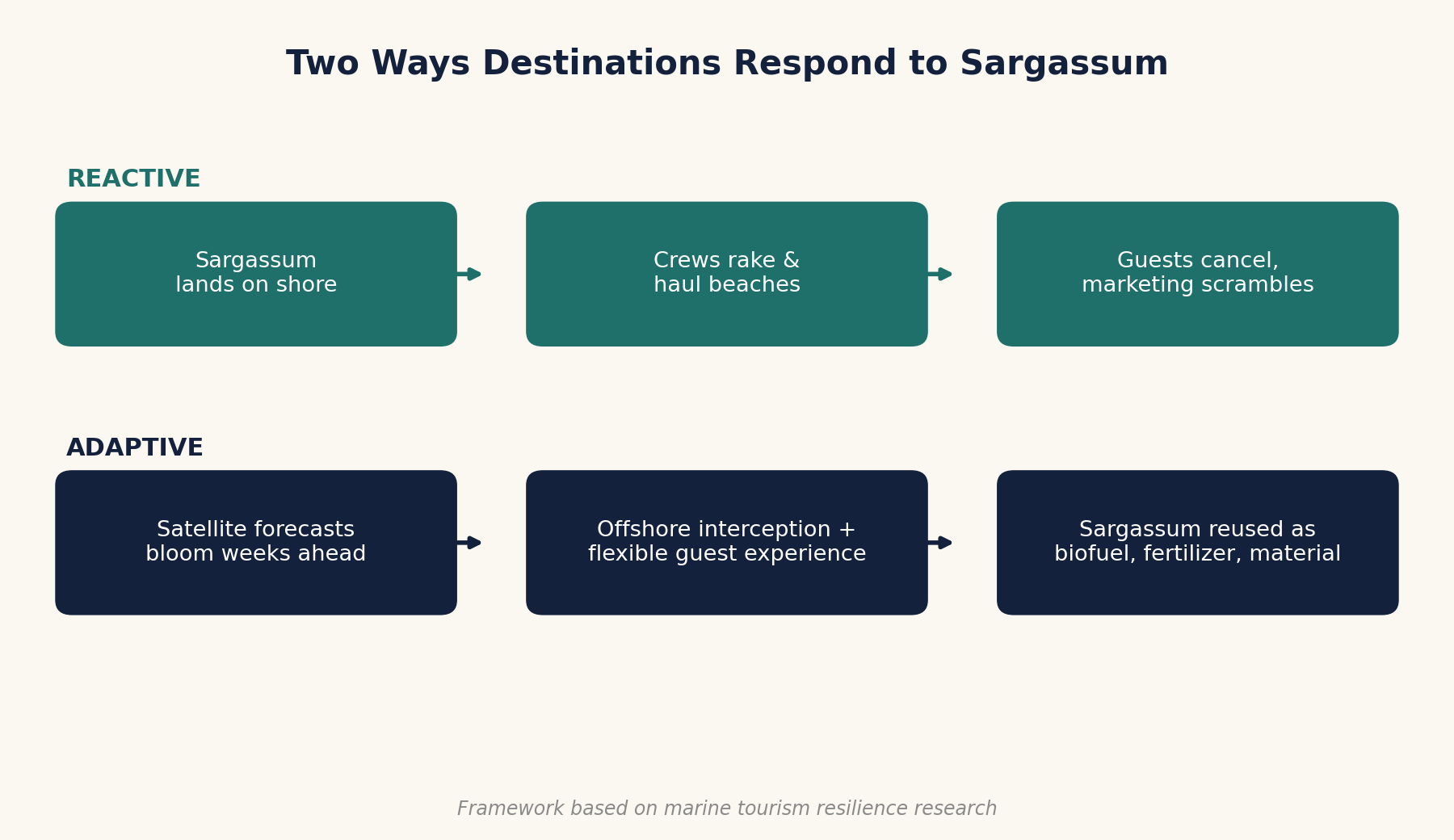
Diagram comparing reactive sargassum cleanup (landing, raking, cancellations) to research-informed adaptive marine tourism management (forecasting, offshore interception, reuse)
Connection to Community-Led Marine Tourism Models
This is where the sargassum crisis connects to a larger argument about resilience. The destinations adapting best are rarely the ones with the biggest cleanup budgets alone. They are the ones where local fishers, dive operators, and researchers are embedded in the response rather than brought in after the fact. Local operators often hold granular, real-time knowledge of current patterns and landing sites that satellite data alone cannot replace, and when the economic benefits of adaptive strategies flow back into the communities doing the work, resilience becomes something a place has a stake in sustaining, not something imposed on it.
That is the throughline of Tourism Case Studies: Community-led Marine Tourism for Resilience, Restoration and Equity: resilience is a governance question as much as a technical one, about who is included in the response and who benefits from the solutions. The sargassum crisis, recurring and worsening, is as clear a test case as exists for that argument.
References
Chiomante, P. (2026, August 14). Mexico races to clear record seaweed surge from Caribbean beaches. Reuters. https://www.reuters.com/business/environment/mexico-races-clear-record-seaweed-surge-caribbean-beaches-2026-08-14/
Hansen, K. (2026, July 29). Sizing up the Sargassum belt. NASA Earth Observatory. https://science.nasa.gov/earth/earth-observatory/sizing-up-the-sargassum-belt/
Qi, L., et al. (2026). Hyperspectral OCI/PACE observations of the Atlantic Sargassum. Remote Sensing of Environment, 334, 115185.
University of South Florida, College of Marine Science. (2026, June 30). Outlook of 2026 Sargassum blooms. Optical Oceanography Laboratory. https://optics.marine.usf.edu/projects/SaWS.html
Zhang, Y., et al. (2025). Dramatic decline of Sargassum in the north Sargasso Sea since 2015. Nature Geoscience, 18, 1266-1272.